
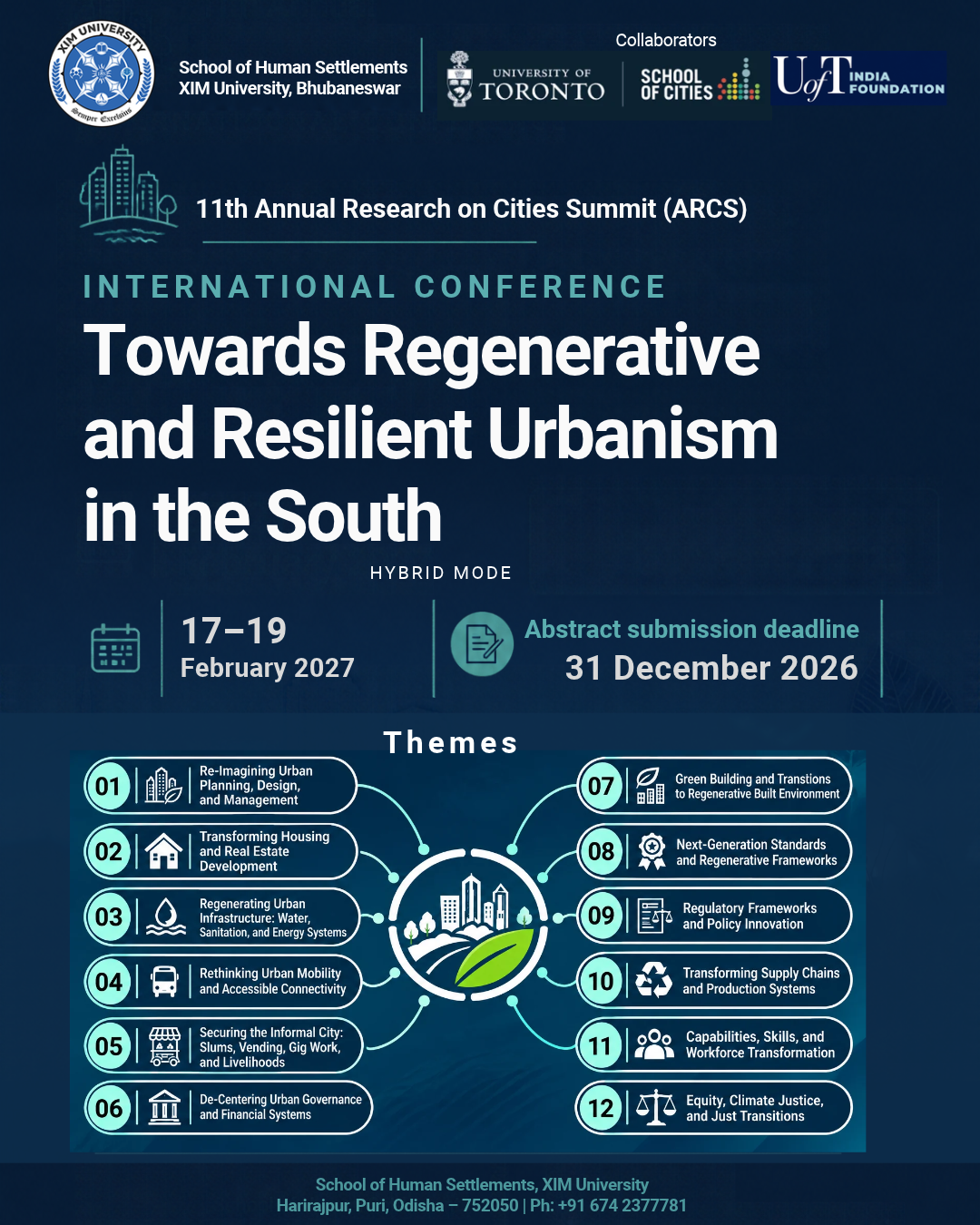
11th Annual Research on Cities Summit (ARCS 11.0)
International Conference
Towards Regenerative and Resilient Urbanism in the South
School of Human Settlements
XIM University, Bhubaneswar, India
17-19 February 2027 (HYBRID MODE)
ANNOUNCEMENT
ARCS 9.0 will now held on 13-14 February 2025
We would like to inform you that, due to some operational reasons, the ARCS 9.0 conference dates have been rescheduled to 13th–14th February 2025 (previously scheduled for 6th–7th February 2025). We kindly request you to adjust your plans accordingly.
To accommodate this change, we are also extending the abstract submission deadline to 15th January 2025.
The registration link and accommodation details we will be sharing shortly.
We regret any inconvenience this may cause and sincerely appreciate your understanding. We look forward to your continued participation and collaboration to ensure the success of the conference.
Cities across the Global South are at a critical crossroads. Faced with the compound pressures of rapid, unplanned urbanization, severe climate vulnerabilities, ecosystem collapse, and systemic socio-economic inequalities, traditional frameworks of city-making and management are proving obsolete. Historically, urban development has relied on a linear, extractive model: take resources, consume them, and discard waste. Even present “sustainable” approaches often do only damage control—minimizing carbon footprints or slowing down environmental degradation or aiming for a net-neutral position. But the scale of the crisis demands a paradigm shift in urban planning and management approaches – from add-on “greening”, siloed initiatives and symptomatic cures to rethinking the shape and substance of urban development towards Regenerative and Resilient Urbanism.
Regenerative Urbanism means thinking and working for a true, eco-systemic sustainability. The city is understood not as a machine, but as a living ecosystem; concern shifts from a net-negative or net-neutral impact to a net-positive contribution to the biosphere; planning and management approaches actively restore, renew, and revitalize both the natural environment and human societies.
Resilient Urbanism approaches are necessary to ensure that communities, ecosystems, and infrastructure can resist, absorb, recover from, and adapt to acute shocks (such as unpredictable monsoons, extreme weather and natural disasters) and chronic stresses (such as water scarcity and extreme heat) which are increasing.
What does such a paradigmatic shift involve? What does it mean in how we imagine, plan, develop and manage places, infrastructure and systems? New approaches and practices also imply shifts in how cities are governed, how organizational architectures are set up and what capabilities must be built – so what changes are needed in these? How are the many efforts and variety of initiatives already being taken, playing out?
This conference invites thought leaders, policymakers, urban planners, scholars, activists, and practitioners to present and discuss these ideas and efforts towards resilient and sustainable urbanism. We invite posters, research papers, cases, experiences, policy critiques and evaluation, essays and propositions that consider how shifting toward a regenerative lens fundamentally transforms our established paradigms of urban planning, management, governance, infrastructure systems, and the everyday informal economies that sustain urban life.
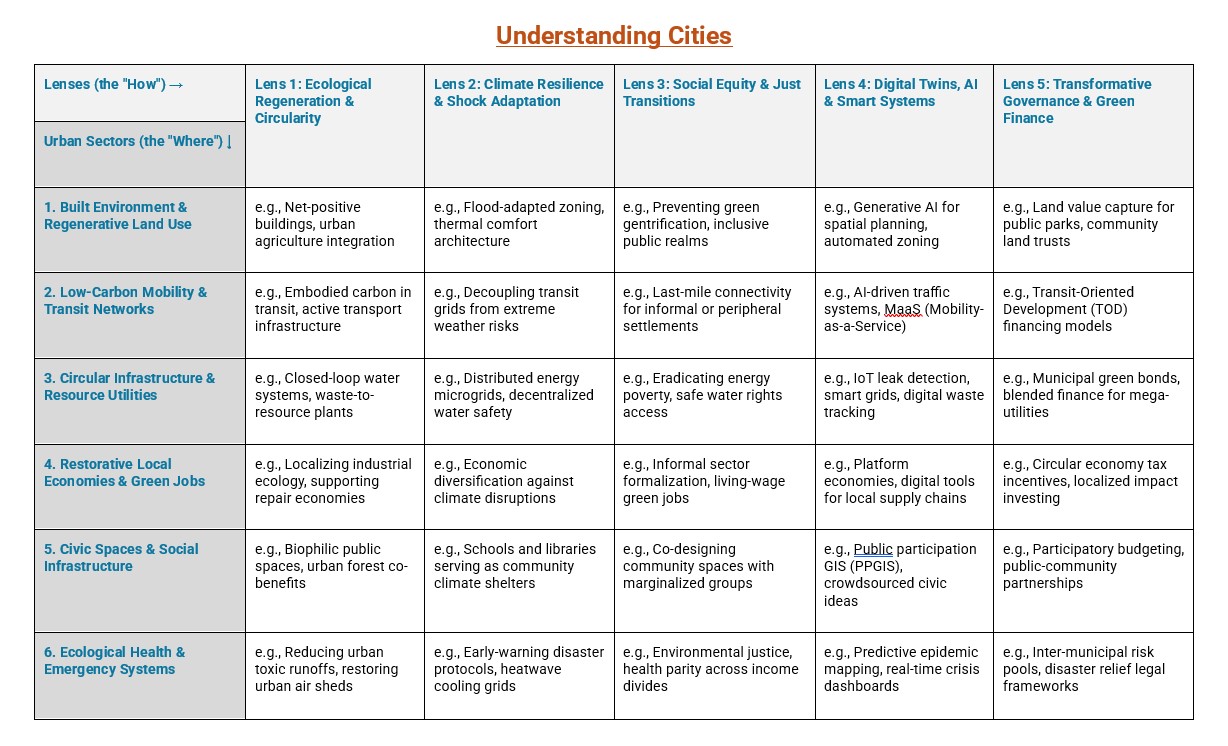
ARCS 11 breaks away from traditional siloed tracks. Cities are worlds in themselves – multi-sectoral, multi-layered and functioning in the confluence of multiple systems; and these sectors or layers can be examined through various lenses, from risk reduction and resilience to equity and just transitions. All urban “sectors” or systems thus have to be rethought from a variety of perspectives, including ecological regeneration, circularity, climate risk, resilience & shock adaptation, social equity & just transitions, use of AI & smart systems, transformative governance and management, green finance, design and planning, as in the matrix below.
CALL FOR PAPERS, CASES, PRESENTATIONS
Submissions can relate to any of the sectors/ systems, and address issues from one or more of the various perspectives (lenses). A set of sample areas and questions are also given below, to serve as organizing themes for your submissions. We welcome multidisciplinary and transdisciplinary (problem-focused) papers and unconventional explorations.
Some Indicative Areas / Themes:
1: Re-Imagining Urban Planning, Design, and Management
How does a regenerative lens alter the foundational tools of urban design and land-use planning, moving away from rigid, concrete-heavy zoning toward dynamic, living landscapes? What approaches, techniques and technologies need to be adopted?
- Nature-Based Solutions (NbS) & Blue-Green Infrastructure: Transitioning from traditional gray infrastructure (concrete storm drains) to sponge cities, urban wetlands, and mangrove restoration to manage floods and combat urban heat.
- Biophilic Urbanism: Integrating biodiversity corridors, urban forestry, and agroecology into core city designs to restore depleted local ecosystems and microclimates.
- Circular Land and Resource Zoning: Designing high-density, mixed-use developments that legally mandate permeable surfaces, protect ecological zones, and actively generate local clean energy and food.
2: Transforming Housing and Real Estate Development
How can housing and large-scale urban development projects evolve from carbon-heavy liabilities into active ecological assets?
- Regenerative Housing & Embodied Carbon: Shifting construction practices away from energy-intensive concrete and steel toward climate-adapted, bio-based materials and passive cooling designs.
- Incremental Settlement Upgrading: Re-conceptualizing informal settlements not as blights to be cleared, but as centers of resourcefulness. Interventions focus on in-situ upgrading through community-managed green infrastructure, secure land tenure, and decentralized sanitation.
- Circular Building Lifecycles: Adopting architectures that can be disassembled, adapted, and reused, eliminating the extractive cycle of demolition and landfill waste.
3: Regenerating Urban Infrastructure: Water, Sanitation, and Energy Systems
Can business-as-usual with centralized networks alone provide universal and sustainable access to basic utilities in the Global South? What types of closed-loop, decentralized and adaptive utility systems can work?
- Decentralized and Circular Water Paradigms: Implementing localized rainwater harvesting, waste-water reclamation, and decentralized treatment systems that treat sewage as a resource rather than a waste product.
- Zero-Waste Circular Economies: Moving away from traditional dumpsites toward community-led, decentralized sorting, composting, and waste-to-resource hubs that generate local employment and organic fertilizers.
- Distributed Renewable Energy Grids: Deploying neighborhood-level solar microgrids and clean energy infrastructure to ensure energy sovereignty and climate resilience for vulnerable communities.
4: Rethinking Urban Mobility and Accessible Connectivity
Transportation systems dictate how a city breathes. How can the way people and goods move be reshaped in resilient and regenerative ways?
- Low-Carbon, Multi-Modal Networks: Integrating clean mass transit with extensive, shaded, pedestrian-friendly, and non-motorized transport pathways designed to withstand extreme weather events.
- Tactical Urbanism for Transit Justification: Converting redundant vehicular right-of-ways into green corridors and pedestrian plazas that simultaneously absorb rainwater and stimulate local commerce.
- Last-Mile Resilience: Ensuring that transport planning prioritizes accessibility for peripheral and low-income neighborhoods, reducing economic shocks for vulnerable commuters.
5: Securing the Informal City: Slums, Vending, Gig Work, and Livelihoods
Informal urban activities are the lifeblood of Southern cities. How can resilience be built into the informal economy while acknowledging its role in ecological sustainability?
- Regenerative Informal Workscapes: Designing public spaces that provide shade, clean water, and climate-safe working conditions for street vendors, waste pickers, and gig workers facing extreme heat.
- Just Transitions for Waste Pickers: Formalizing the role of informal waste pickers as recognized, fairly compensated environmental stewards at the frontline of circular urban economies.
- Social Protection Nets against Climate Shocks: Developing financial and social safety nets (such as micro-insurance and heat-stress payouts) to protect gig and informal workers from immediate climate disruptions.
6: De-Centering Urban Governance and Financial Systems
How can urban governance, planning and management practices become adaptive, inclusive, and politically empowering? How can resources be channeled to this?
- Co-Design and Polycentric Governance: Moving from top-down municipal mandates to co-governance models where community-led neighborhood councils actively participate in budgeting and climate adaptation strategies.
- Financing the Regenerative Transition: Exploring innovative financing mechanisms—such as municipal green bonds, climate adaptation funds, and community land trusts—tailored specifically to the fiscal constraints of the Global South.
- Integrating Indigenous and Decolonial Knowledge: Leveraging historical, time-tested Southern practices of climate adaptation and collective resource management alongside modern spatial data analytics.
7: Green Building and Transitions to Regenerative Built Environment
How can we transform the built environment to become resilient and regenerative? What changes are needed in the production systems, capabilities and regulatory frameworks to enable regenerative transitions?
- Ecosystem Services Integration: Architectures that actively purify air, manage local stormwater, and restore natural urban habitats.
- Built Form, Design and Materials: In a production-led and market-based domain with installed capacities and established systems, can a transition be made to eco-sensitive materials and design? What examples or experiences can illustrate possible pathways to change?
8: Next-Generation Standards & Regenerative Frameworks
- Beyond Net-Zero: Frameworks and metrics for net-positive energy, water-positive, and carbon-fixing builtforms.
- Evolution of Green Rating Systems: Adapting LEED, BREEAM, WELL, or local ratings to measure biodiversity, climate resilience, and regenerative impacts.
- Life Cycle Regeneration: Methods for measuring and reducing embodied carbon, toxic materials, and whole-life building impacts.
9: Regulatory Frameworks & Policy Innovation
- Performance-Based Codes: Shifting building regulations from prescriptive checklists to real-world, dynamic performance outcomes.
- Policy Levers for Decarbonization: Mandating circular construction, adaptive reuse, and strict embodied carbon limits in municipal zoning.
- Deconstruction & Waste Legislation: Regulatory mandates for material passports, right-to-repair for buildings, and zero-waste construction sites.
- Climate Risk Disclosures: Aligning building codes with municipal climate adaptation goals, flood plain management, and extreme heat resilience.
10: Transforming Supply Chains & Production Systems
- Low-Carbon & Bio-Based Materials: Innovations in scaling mass timber, earthen materials, mycelium, and agricultural waste composites.
- Circular Material Economies: Up-cycling industrial by-products into high-performance building components.
- Industrialized & Modular Construction: Using prefabrication and 3D printing to minimize material waste and accelerate green building deployment.
- Supply Chain Transparency: Blockchain and digital tracking for ethical sourcing, fair labor, and carbon accounting in construction logistics.
11: Capabilities, Skills, & Workforce Transformation
- Just Transitions for Construction Labor: Reskilling traditional construction workers for green technologies, energy retrofits, and safe material handling.
- AI and Digital Twins in Green Building: Leveraging machine learning, building information modeling (BIM), and smart sensors for predictive energy and water management.
- Interdisciplinary Capabilities: Educational models that integrate ecology, sociology, and indigenous knowledge into architecture and engineering curricula.
- Institutional Capacity Building: Training code officials, inspectors, and urban planners to evaluate novel, eco-friendly building methods.
12: Equity, Climate Justice, & Just Transitions
- Affordable Resilience: Ensuring energy-efficient, climate-resilient housing is accessible to low-income and vulnerable communities.
- Mitigating Green Gentrification: Policy strategies to prevent displacement when eco-districts and green infrastructure are introduced.
- Community-Led Design Regulations: Co-creating building standards with local neighborhoods to respect cultural heritage and specific community vulnerabilities.
- Health and Well-being Metrics: Incorporating indoor environmental quality, acoustic comfort, and mental wellness into standard regulatory frameworks.
Publication
The selected papers from ARCS 11.0 will be considered for publication in an edited volume/peer-reviewed journal with a reputable publisher post-conference. All accepted abstracts will be published with a DOI.
Annual Urban Research Award (AURA)
The best papers in the student category will be awarded the AURA awards.
Registration DETAILS
Participants and presenters are required to register for the conference.
Registration fee includes:
- Admission to the technical sessions
- Admission to all Plenaries and Roundtables
- All conference materials
- Admission to the cultural night and Gala dinner on 17 February 2027 (for offline participants)
- Tea/coffee and lunch for 17-19 February 2027 (for offline participants)
- Certificate (only to the registered attendees and presenters)
Note: The conference fee does not include accommodation and airport transfer. Only limited on-campus accommodation is available for a fee.
Cancellation Policy: In case of cancellation or non-attendance, the registration fee is non-refundable.
Registration Fees for Indian Nationals (including GST)
| ||||
| OFFLINE | ONLINE | ||
Registration Fee (for presenters*) | Amount in ₹ | Amount in ₹ | ||
Early bird | Late | Early bird | Late | |
Industry Professional | 5000 | 6000 | 4500 | 5000 |
Faculty delegate | 3500 | 4500 | 2500 | 3000 |
Research scholars | 2500 | 3500 | 1500 | 2000 |
Student delegate (PG) | 1500 | 2000 | 1000 | 1500 |
Student delegates (UG) | 1000 | 1500 | 1000 | 1200 |
XIM student delegate | 1000 | 1000 | 1000 | 1000 |
Accompanying person (including GST) | ||||
Accompanying person with the presenter but not presenting (will receive only a participation certificate) | 1500 | 2000 | ||
NRI and Foreign Nationals ( approx.USD) | ||||
International delegates (offline) | USD120/ ₹11500 | USD130/ ₹12500 | USD30/ ₹3000 | USD40/ ₹4000 |
*If multiple authors are presenting the paper, each author has to register separately as a presenter to avail the presenter certificate.
NOTE: Author/co-authors not attending the conference in person will not receive a certificate.
Important Dates
Submission deadline for abstracts | 31 December 2026 |
Notification of abstract acceptance | 10 January 2027 |
Early Bird Registration deadline | 25 January 2027 |
Late Registration deadline | 7 February 2027 |
The Conference | 17-19 February 2027 |
Important Links
Abstract* (800- 1000 words) may be submitted to: https://forms.gle/DKiLvjcx1BWBD4sj8
*minimum 800 words is mandatory
All inquiries may be sent to: [email protected]