
10th Annual Research on Cities Summit (ARCS 10.0)
International Conference
New Approaches to Governance and Resilience (NAGAR)
School of Human Settlements
XIM University, Bhubaneswar, India
5th - 7th February 2026
ANNOUNCEMENT
ARCS 9.0 will now held on 13-14 February 2025
We would like to inform you that, due to some operational reasons, the ARCS 9.0 conference dates have been rescheduled to 13th–14th February 2025 (previously scheduled for 6th–7th February 2025). We kindly request you to adjust your plans accordingly.
To accommodate this change, we are also extending the abstract submission deadline to 15th January 2025.
The registration link and accommodation details we will be sharing shortly.
We regret any inconvenience this may cause and sincerely appreciate your understanding. We look forward to your continued participation and collaboration to ensure the success of the conference.
In today’s world, cities are facing an urgent need for new ways of thinking about how they are run and how they grow. As urban areas expand rapidly, especially in the Global South, they are increasingly strained by the effects of climate change, widening social divides, and environmental decline. Existing governance systems often fall short when it comes to managing these overlapping challenges. International agendas like the Sustainable Development Goals (with SDG 11 at the core), the Paris Climate Agreement, and the Sendai Framework for Disaster Risk Reduction all stress the importance of building cities that are inclusive, adaptable, and resilient. This means moving beyond outdated, fragmented approaches and toward planning that is coordinated, forward-looking, and grounded in community involvement. To make cities more livable and just, especially for vulnerable populations, we must reshape how we govern and build urban spaces. It’s not simply about policy—it’s about ensuring a future that works for everyone.
The ARCS 10.0 – NAGAR conference is being shaped as a global meeting ground for people who care deeply about the future of cities. From policymakers, urban managers, planners, to community organizers, researchers, and institutions, this gathering brings together a wide range of voices to reflect on how cities can become more resilient, inclusive, and sustainable. With particular focus on the Global South, where rapid urban growth often intersects with deep social and environmental challenges, the conference offers a space to share lessons, ideas, and new approaches.
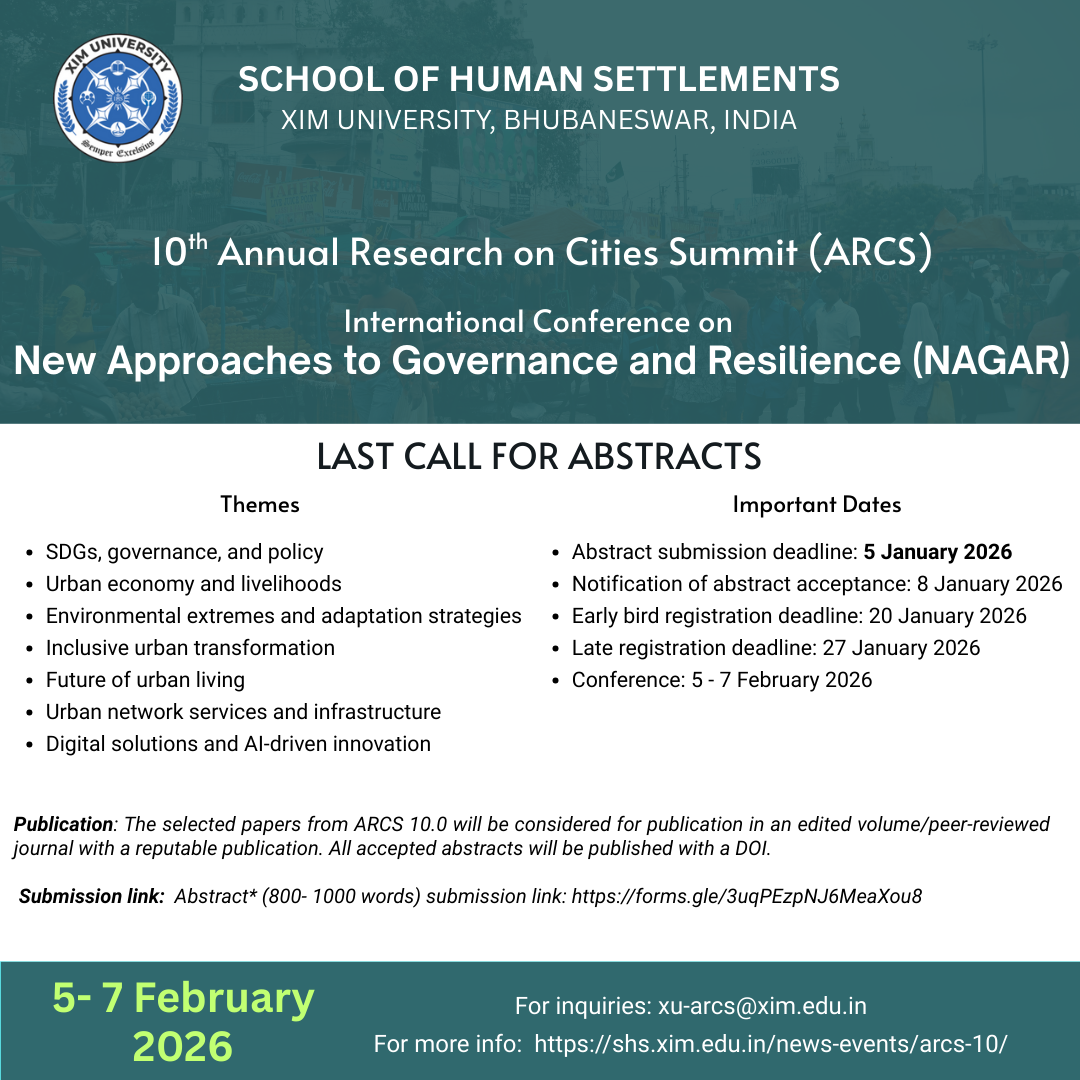
Participants will explore how technologies, policies, and grassroots planning can work together to meet the goals of the SDGs, the Paris Agreement, and the Sendai Framework. The aim is not just to talk, but to build lasting partnerships and practical strategies that help cities become fairer, more adaptive, and better prepared for the future.
Cities today are under more pressure than ever—from rising heat and floods to inequality and fast-growing populations. But with the right approach, they can also be part of the solution.
Resilient cities aren’t built in isolation—they emerge when ecosystems are protected, governance is inclusive, and planning responds to real human needs. Good governance helps communities feel heard and included. Healthy ecosystems, both natural and built, help cities cope with shocks and recover more quickly. And when city centers are connected to their outer edges through thoughtful planning, everyone benefits. By bringing these elements together, we can create urban spaces that are not only efficient and functional but also sustainable to future uncertainties.
CALL FOR PAPERS, CASES, PRESENTATIONS
The multi-disciplinary ARCS 10.0 – NAGAR Conference invites scholars, professionals, students, and civic actors to engage in critical reflection and share empirical insights on how cities, especially in the Global South, can transition toward inclusive, climate-resilient, and sustainable urban futures. In alignment with the Sustainable Development Goals (SDGs), the Paris Agreement, and the Sendai Framework, the conference seeks to examine how governance, policy, planning, and management can shape more adaptive and equitable urban systems.
We invite papers, case studies, project reports, and working paper submissions that explore real-world initiatives, research, and experiences related to urban and regional sustainability. Contributors from all disciplines and practice areas are encouraged to participate and share their work. Submissions should reflect original contributions and clearly indicate their intended track(s) during registration.
1. SDGs, governance, and policy: Institutions, participation, and evidence-based frameworks
The Sustainable Development Goals (SDGs) offer a shared global vision for tackling some of the most urgent and complex environmental, social, and economic challenges facing humanity. But translating this vision into meaningful action requires more than just long-term planning. It depends on strong and inclusive governance, well-designed policies grounded in evidence, and institutions that are both accountable and adaptable. This conference theme invites participants to examine how national and local governance systems can work in concert with policy innovation and multi-stakeholder collaboration to advance the SDGs. By fostering dialogue on coherent policy frameworks, participatory decision-making, and institutional resilience, the theme seeks to uncover pathways for accelerating equitable and sustainable development. It calls on practitioners, researchers, and policymakers to reflect on what it takes to create governance systems that not only deliver on global goals but also empower communities and build lasting capacity for change. The sub-themes include:
- Evidence-based policymaking
- Multi-Level governance and institutional coordination
- Participatory governance and civic engagement
- Financing and regulatory mechanisms for the SDGs
2. Urban economy and livelihoods: Circular economy, inclusive growth, and resilient livelihoods
As cities continue to grow and reshape the global landscape, they are increasingly recognized as vital hubs of economic activity, innovation, and opportunity. Yet, the speed and scale of urbanization often deepen existing inequalities and strain natural resources. This theme focuses on reimagining urban economies in ways that not only drive growth but also ensure that such growth is inclusive, resilient, and environmentally responsible. It explores how principles of the circular economy—such as resource efficiency, reuse, and regenerative systems—can be embedded into urban development to support both economic vibrancy and sustainability. This theme will engage in interdisciplinary dialogue around resilient livelihoods that can withstand economic and environmental shocks, particularly in the context of the Global South. The theme emphasizes the need to diversify income sources, support informal and creative economies, and design policy frameworks that prioritize equity and adaptability. By rethinking how urban systems value work, waste, and wellbeing, this track aims to uncover practical pathways toward economic models that empower communities while safeguarding the planet. The sub-themes are:
- Economic growth
- Circular Economy
- Inclusive and Resilient Livelihoods
- Local economic development and urban-rural linkages
3. Environmental extremes and adaptation strategies: Attaining resilience through sustainable approaches
Extreme weather events like heatwaves, floods, droughts, wildfires, and storms are becoming more frequent and intense, affecting our ecosystems, communities, health, and economies in serious ways. This conference brings together researchers, policymakers, practitioners, and community leaders to better understand these challenges and to share practical ways to adapt. It values approaches that combine scientific insights with local and traditional knowledge, recognizing that real resilience comes from communities working together. By encouraging open conversations across different fields and experiences, the conference hopes to inspire solutions that not only reduce risks but also help people and places become stronger and more prepared for whatever comes next.
- Natural hazards and society
- Nature-based solutions (NBS)
- Role of community in disaster risk reduction
- Adaptation and mitigation strategies
- Environment, Social and Governance (ESG)
4. Inclusive urban transformation: Placemaking, identity, and equity across age and gender
In an era marked by rapid urbanization and widening social inequalities, the concept of inclusive transformation calls for a fundamental rethinking of how cities are designed and governed to better reflect the diverse needs, identities, and aspirations of all residents. This theme critically examines how inclusive placemaking can help address disparities across dimensions such as gender, age, culture, and identity, fostering urban environments that are equitable, diverse, and resilient. It invites thoughtful dialogue on the role of urban design, participatory governance, and meaningful community engagement in shaping public spaces that promote a sense of belonging, safety, accessibility, and cultural expression for everyone. By centering inclusivity in urban transformation, this approach aims to build cities where all individuals can thrive and participate fully in civic life. The sub-themes are:
- Inclusive and resilient placemaking
- Gender-responsive planning and management
- Role of culture and identity
- Age-Sensitive planning and management
- Equity, belonging, and urban justice
5. Future of urban living: Trends in housing and real estate
The housing and real estate sector is undergoing rapid transformation driven by urbanization, technological innovation, demographic shifts, and evolving economic dynamics. This theme addresses the question of how these changes are reshaping the way we plan, finance, and govern living spaces. It invites dialogue on building inclusive, resilient, and sustainable communities through innovative housing models, smart technologies, and equitable policy frameworks. As cities grow and diversify, the challenge lies in ensuring that housing is accessible, adaptable, and responsive to human needs. This theme encourages collaboration across disciplines to envision housing not just as infrastructure, but as a catalyst for social stability, dignity, and opportunity. The sub-themes are:
- Affordable Housing and Inclusive Development
- Smart and Sustainable Housing
- Real Estate Investment and Market Dynamics
- Land Use Planning and Management
- Land Markets, Property Rights, and Governance
6. Urban network services and infrastructure: Innovation, integration, and accessibility
As cities expand rapidly, the need for reliable, equitable, and resilient urban services like water, sanitation, hygiene (WASH), transportation, and education becomes more pressing than ever. These essential services form the foundation of inclusive, healthy, and sustainable urban life. This theme seeks to foster interdisciplinary conversations on overcoming challenges and driving innovation in these sectors. It emphasizes developing policies and practices that improve accessibility, affordability, and quality, while addressing social disparities and equipping cities to meet future growth and environmental pressures. The sub-themes are:
- WASH
- Sustainable Urban Transportation
- Education Infrastructure and Accessibility
- Infrastructure finance
7. Digital solutions and AI-driven innovation: Smart application, E-governance, and ethical tech
Digital solutions and AI-driven innovations are rapidly transforming how cities are managed, offering new tools to tackle complex urban challenges with greater efficiency and insight. This theme explores the potential of technologies such as artificial intelligence, big data analytics, and smart sensors to enhance urban governance, service delivery, and resilience. The theme will explore how these innovations can promote inclusive, transparent, and adaptive urban systems, while addressing ethical considerations and digital divides. By integrating technology with community needs, cities can become more responsive, equitable, and prepared for the future. The sub-themes are:
- Smart Technologies and AI for urban solutions
- Digital governance in decision making
- Role of AI and digital infrastructure in urban management
- Ethical challenges in the implementation of AI
Publication
The selected papers from ARCS 10.0 will be considered for publication in an edited volume/peer-reviewed journal with a reputable publication. All accepted abstracts will be published with a DOI.
Registration DETAILS
The Registration link for ARCS 10.0 is OPEN now. Kindly complete the registration process before 20 January 2026 (early bird)** and late registration till 27 January 2026**
**If you have more than one accepted abstract, please register separately.
Registration Process:
Step1: Registration Payment Link: https://rzp.io/rzp/jeqk7FmD
Step2: After completion of registration fee payment, take a screenshot/ receipt of the payment and fill out the google form in the link below (mandatory):
A special tour program is organised on a paid basis on 7 February 2026, covering Bhubaneswar and Puri. Participants may indicate their interest on the same link below ( step 2)
https://forms.gle/zuc3e91NGaFjbadL9
Important Registration Information for Co-authors:
- Multiple Authors: If multiple authors present the paper in person, each author MUST register separately as a presenter to avail of the presenter certificate.
- Accompanying Person/Co-author: Those accompanying the presenter but not presenting will receive only a participation certificate.
- For all XIM students (UG/PG/RS) kindly select XIM Student in Step 1.
- *For XIM faculty and staff, there is no registration fee. (only step 2 is applicable, attach university ID instead of payment receipt)
** Author/ co-authors/ attendees must present/ attend the conference in person to receive a certificate (only registered participants). Please don’t email post-conference asking for a certificate.
Registration Fee Includes:
- Admission to the technical sessions.
- Admission to Plenaries and Special workshop: InnovateX -Emerging Technologies for Sustainable Cities.
- All-Conference materials.
- An invitation to the Special event (Cultural and Gala Dinner)
- Tea/coffee and lunch
- Certificate (only to the registered participants)
Note: The conference fee does not include accommodation, tour program and airport transfer. Only limited accommodation is available on campus on a paid basis. The booking link for accommodation will open shortly.
Cancellation Policy: The registration fees are not refundable in case of cancellation or non-attendance.
Annual Urban Research Award (AURA)
The best papers in the student category will be awarded the AURA awards.
One-Day tour
A one-day tour on 7th February 2026, Bhubaneswar- Puri-Konark, is being arranged for conference participants, available on a payment basis. Delegates interested in joining this cultural and heritage tour are warmly invited to register separately for the tour. More details (pricing, tour plan, registration process) will be shared shortly.
Registration Fees for Indian Nationals (including GST) | ||
Registration Fee (for presenters*) |
Amount in ₹ | |
Early bird | Late | |
Industry Professional | 7000 | 9000 |
Faculty delegate | 5000 | 6000 |
Research scholars | 3500 | 4500 |
Student delegate (PG) | 2500 | 3500 |
Student delegates (UG) | 1500 | 2000 |
XIM student delegate | 1000 | 1000 |
Accompanying person (including GST) | ||
Accompanying person with the presenter but not presenting (will receive only a participation certificate) | 2000 | 3000 |
NRI and Foreign Nationals (Hybrid) | ||
International delegates (offline) | USD115/ ₹10000 | USD125/ ₹11000 |
International delegates (online) | USD20/ ₹1800 | USD25/ ₹2200 |
*If multiple authors are presenting the paper, each author has to register separately as a presenter to avail the presenter certificate.
NOTE: Author/co-authors not attending the conference in person will not receive a certificate.
Important Dates
Submission deadline for abstracts | 5th January 2026 |
Notification of abstract acceptance | 8th January 2026 |
Early Bird Registration deadline | 20th January 2026 |
Late Registration deadline | 27th January 2026 |
The Conference | 5th – 7th February 2026 |
Important Links
Abstract* (800- 1000 words) may be submitted to: https://forms.gle/HXwXMXc3HrJKLdbG6
*minimum 800 words is mandatory
All inquiries may be sent to: [email protected]
More Updates on
SHS website: https://shs.xim.edu.in/
Facebook: https://www.facebook.com/humansettlements.XIMUniversity
Instagram: https://www.instagram.com/shs_xim_university/
Linkedln:https://www.linkedin.com/company/school-of-human-settlements-xim-university/
| THEMES | SDGs and Policies | Informality | Equity and Inclusion | Gender | Smart & Digital Applications |
|---|---|---|---|---|---|
|
TRACKS |
Economy & livelihood |
||||
|
Sustainable Infrastructure and services |
|||||
|
Environment & Ecosystem |
|||||
|
Urban Regeneration and Public Spaces |
|||||
|
Settlement Planning and development |
|||||
|
Urban Governance |
|||||
|
Capacity building and education |
|||||
CONFERENCE TRACKS
Track 1: Economy and Livelihood
This track will address the issues of economic development, growth, and creating equal, secure, and decent livelihood opportunities for all. It will answer the questions of sustainable livelihood approaches strategies. How does focusing on inclusive livelihood can lead to economic development? What are the various ways of achieving the same? What are the innovative techniques of income generation? What are the existing scenarios in the global south? The track is further divided into the following sub-themes:
- Economy of cities and its region
- Sustainable livelihood of the global south: approaches, policies, case studies
- Economic growth and cities of the global south
Track 2: Sustainable Infrastructure and Services
This track will look into the global south’s sustainable urban infrastructure (social and physical), like housing, transportation, delivery of basic services, and its management. It will also focus on WASH’s approaches, policies, and practices in the southern cities and its region. it will stress the questions of sustainable ways of transportation in terms of their social and environmental impact. How do accessibility, quality, and equity in WASH make cities clean, green, and healthy? How does a circular economy promote resource-efficient living? How is affordable housing contributing to the well-being of people?
- WASH in the global south
- Sustainable Transportation: towards green mobility
- Affordable housing and real estate in the southern cities: policies, impact, and practices
- Circular economy in promoting resource-efficient cities
- Case studies
Track 3: Environment and Ecosystem
This track will answer the question of achieving climate-resilient cities. What are the approaches, policies, and innovative planning to reduce the impact of climate change? What are the challenges and solutions in making cities resilient to disaster? How can the differential impact of climate change and disaster be addressed? The theme is further divided into the following sub-theme to answer these questions specifically:
- Climate-resilient sustainable cities- Adaptation strategies, present scenarios, and various approaches
- Disaster Risk Reduction: Practice and policies in the global south
- Case studies and best practices of inclusive resilient planning and management of cities and regions
- Nature-based solution for climate change and disaster mitigation
Track 4 : Sustainable Settlement Planning and Development
This theme will answer the urban, peri-urban, and rural landscape questions and their dynamics. Role of migration in shaping cities? What are the dynamics of the city region? What are the challenges in sustainable settlement planning and approaches? Exploring the rural-urban linkages and livelihood perspective. It is further divided into the following sub-themes:
- Dynamics of urban, peri-urban, and rural landscapes
- Rural-Urban Migration: Impact and Management
- Settlement Planning and Sustainable Land Use
- Rural-urban linkages and its dynamics in development
Track 5 : Inclusive Urban Regeneration and Public Spaces
The track revolves around creating public spaces considering beauty, quality, accessibility, connectivity, and resilience for sustainable urban regeneration. How is place making changes over identity, culture, and geography? How can we address the challenge of inclusivity in sustainable urban regeneration through place-making? Gentrification and conflict between formal and informal placemaking. It has the following sub-themes:
- Urban Regeneration: Social Inclusion and Equity
- Age-Friendly and Gender-Sensitive Urban spaces
- Sustainable placemaking: Policies and approaches
Track 6: Urban governance
Track 6 examines innovative planning and development approaches adopted for sustainability in the global south. How are the governance structure and policies in cities addressing sustainability? It will also focus on case studies, sustainable city framework, best practices, etc. This theme is further divided into the following sub-themes:
- SDGs and urban policy alignment in the global south
- Future sustainable cities- prospects and challenges
- Innovative Governance Strategies for Urban Sustainability
Track 7: Urban capacity building and education
This track will focus on capacity building of the urban planner, managers, and decision-makers. Why is it crucial to address the issue of capacity building among urban professionals and create awareness among the young generation for a sustainable future of cities? It will discuss institutional and human capacity-building practices, impacts, approaches, and policies. It will also address the existing scenarios of planning education in the global south, its issues, and what can be done. This track is divided into the following sub-themes:
- Capacity building of urban professionals in the global south
- Planning education for sustainable urban development
- Future of cities, planning education and urban professionals: approaches and strategies for way forward
Registration
All the attendees and presenters are required to register for the conference.
Registration Fee Includes:
- Admission to the technical sessions
- Admission to all Plenaries and Roundtables
- All-Conference materials
- An invitation to the Special event (cultural and dinner)
- Tea/coffee and lunch
- Certificate (only to the registered attendees and presenters)
Note: The conference fee does not include accommodation and airport transfer. Only limited accommodation is available on campus.
Cancellation Policy: The registration fees are not refundable in case of cancellation or non-attendance.
Registration Fees for Indian Nationals | ||
Registration Fee ( for presenters*) | Amount in INR Early bird |
Late |
Industry Professional | 4000 | 4500 |
Faculty delegates | 3000 | 3500 |
Student delegates (PG & Above) | 2000 | 2500 |
Student delegates (UG) | 1200 | 1500 |
Thesis Presentation | ||
Student delegates (PG & RS) | 2000 | 2500 |
Student delegates (UG) | 1200 | 1500 |
Accompanying person | ||
Accompanying person with the presenter but not presenting (will receive only participation certificate) | 1000 | 1500 |
NRI and Foreign Nationals | ||
International delegates | 6000 | 7000 |
*If multiple authors are presenting the paper, each author has to register separately as a presenter to avail the presenter certificate.
NOTE: Author/co-authors not attending the conference in person will not receive any certificate. Please do not email requesting a certificate post-conference.
Important Dates
Submission deadline for abstracts | 31st December 2023 |
Notification of abstract acceptance | 5th January 2024 |
Early Bird Registration deadline | 10th January 2024 |
Late Registration Deadline | 22nd January 2024 |
The Conference | 8-10 February 2024 |
Important Links
Abstract (800- 1200 words) may be submitted to: https://forms.gle/wEsqSc97yUfiGe4C6
Abstract template for submission: https://docs.google.com/document/d/1FSt3LKQDWS7MCkmrON-csr6LXOS88mDv/edit?
All inquiries may be sent to: [email protected]
More Updates on:
SHS website: https://shs.xim.edu.in/
Facebook: https://www.facebook.com/humansettlements.XIMUniversity
Instagram: https://www.instagram.com/shs_xim_university/
Linkedln:https://www.linkedin.com/company/school-of-human-settlements-xim-university/